
Chemical safety is an important consideration in laboratories, industrial facilities, research institutions, and workplaces where chemical substances are handled or stored.
Some chemicals may present physical, health, or environmental hazards. Understanding these risks is essential for developing appropriate safety procedures and protecting people and the environment.
One of the most effective ways to communicate chemical hazards is through standardized chemical hazard symbols.
These symbols help users identify potential dangers by providing clear visual warnings on chemical labels and safety documentation.
In this guide, we explore the Globally Harmonized System (GHS), explain the different chemical hazard symbols, and discuss why understanding these pictograms is important.
What Are Chemical Hazard Symbols?
Chemical hazard symbols are standardized visual indicators used to communicate potential dangers associated with chemical substances and mixtures.
They are commonly displayed on chemical containers, product labels, and Safety Data Sheets (SDS).
These symbols help workers, laboratory personnel, and other relevant users recognize potential hazards before handling a chemical.
The Globally Harmonized System of Classification and Labelling of Chemicals (GHS) provides an internationally recognized framework for communicating chemical hazards.
What Is the Globally Harmonized System (GHS)?
The Globally Harmonized System, commonly known as GHS, was developed by the United Nations to improve consistency in chemical hazard classification and communication.
Before standardized systems became widely adopted, different countries often used different labeling methods. This could create confusion when chemicals were transported or used internationally.
GHS helps address this challenge through harmonized classification criteria, standardized pictograms, signal words, and hazard statements.
The system is implemented through national and regional legislation, including the European Union’s CLP Regulation.
The Nine Main GHS Chemical Hazard Pictograms
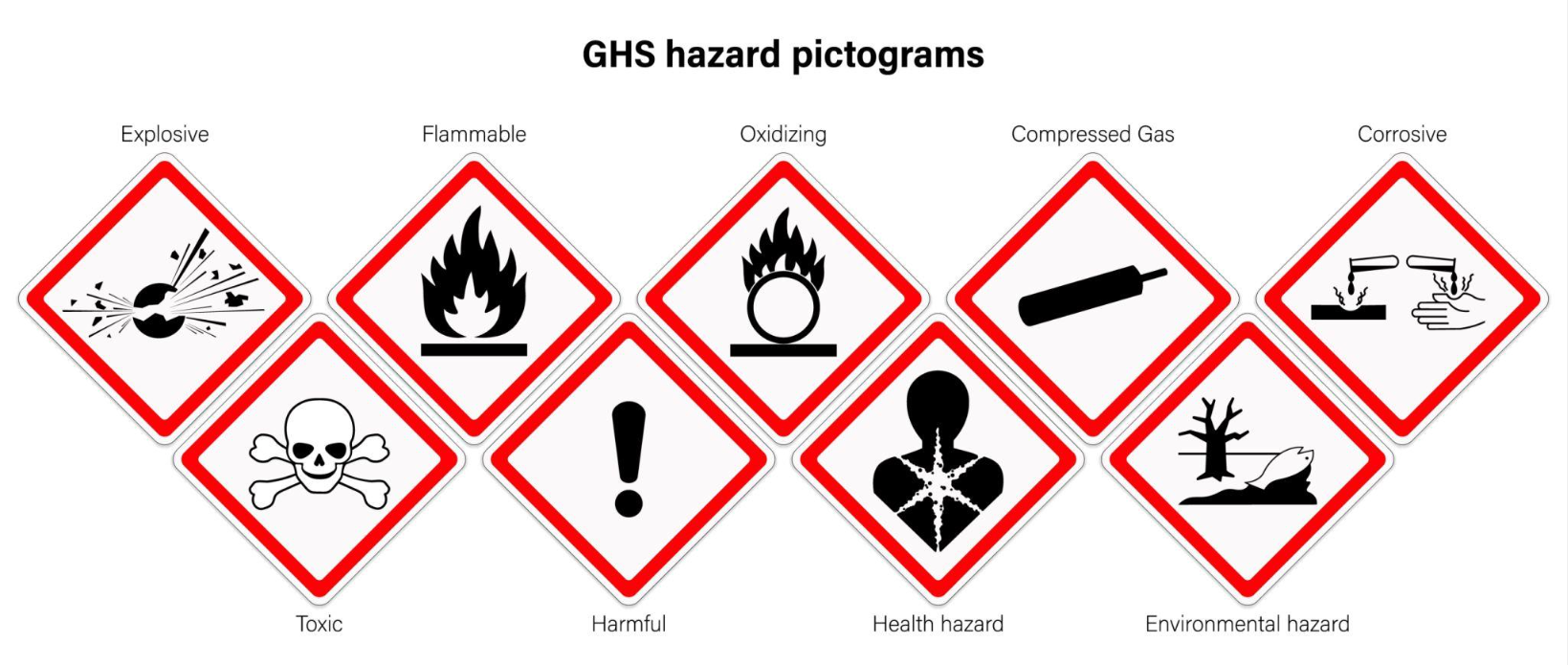
GHS includes nine standardized hazard pictograms. Each represents a particular category of potential hazard.
1. Exploding Bomb
The exploding bomb pictogram indicates certain explosive, self-reactive, and organic peroxide hazards.
It communicates the possibility of an explosion or violent reaction under specified conditions.
2. Flame
The flame pictogram identifies certain flammable substances and other chemicals that may present fire-related hazards.
It is commonly associated with flammable gases, liquids, solids, and certain reactive substances.
3. Flame Over Circle
This pictogram represents oxidizing substances.
Oxidizers may cause or intensify a fire by supporting combustion, even when they are not themselves combustible.
4. Gas Cylinder
The gas cylinder symbol indicates gases under pressure.
Such gases may present hazards associated with pressure, leakage, or temperature-related effects.
5. Corrosion
The corrosion pictogram identifies substances that may cause serious skin burns, eye damage, or corrosion of metals.
Appropriate precautions and protective measures are essential when dealing with substances carrying this classification.
6. Skull and Crossbones
This pictogram indicates acute toxicity hazards that may cause serious harmful effects or death following exposure.
The applicable classification depends on the toxicity category.
7. Exclamation Mark
The exclamation mark pictogram may indicate several less severe health hazards.
These can include skin irritation, eye irritation, or certain forms of acute toxicity.
8. Health Hazard
The health hazard pictogram represents certain serious or chronic health hazards.
Depending on the classification, these may include respiratory sensitization, carcinogenicity, reproductive toxicity, or specific target organ toxicity.
9. Environment
The environmental hazard pictogram indicates hazards to aquatic environments.
It highlights the importance of preventing inappropriate releases into water systems and the surrounding environment.
Why Are Chemical Hazard Symbols Important?
Chemical hazard pictograms serve several important purposes.
Improving Hazard Awareness
Standardized symbols help users recognize potential hazards quickly without relying entirely on lengthy written explanations.
Supporting Workplace Safety
Organizations can use hazard information when developing workplace procedures, training programs, and chemical risk assessments.
Improving Chemical Communication
GHS provides a consistent approach to communicating hazards across different industries and international supply chains.
Supporting Environmental Protection
Environmental hazard information helps organizations recognize potential risks to aquatic ecosystems and take appropriate preventive measures.
Where Can You Find Chemical Hazard Symbols?
Chemical hazard pictograms are commonly found in several places:
- Chemical product labels
- Safety Data Sheets
- Laboratory chemical containers
- Industrial chemical packaging
- Chemical storage documentation
Users should always consult the relevant Safety Data Sheet for detailed hazard and precautionary information rather than relying on pictograms alone.
Best Practices for Chemical Hazard Awareness
Organizations can strengthen chemical safety awareness by following these practices:
- Train relevant personnel to recognize GHS pictograms.
- Review applicable Safety Data Sheets before handling chemicals.
- Maintain accurate chemical labeling.
- Ensure chemical risk assessments are appropriate for the workplace.
- Provide suitable personal protective equipment based on the risk assessment.
- Maintain appropriate storage and emergency procedures.
- Follow applicable local and international chemical safety requirements.
Chemical Hazard Symbols and European Regulations
Within the European Union, chemical classification, labelling, and packaging requirements are primarily established through the CLP Regulation.
CLP incorporates the GHS framework into European legislation and establishes requirements for communicating chemical hazards.
Businesses operating within the European chemical supply chain should understand their applicable responsibilities and maintain accurate chemical safety documentation.
Conclusion
Chemical hazard symbols are an essential part of modern chemical safety communication.
Understanding the nine GHS pictograms helps workers and organizations recognize different categories of chemical hazards and make informed decisions about appropriate safety precautions.
By combining hazard awareness, accurate labeling, Safety Data Sheets, and effective workplace procedures, organizations can support safer chemical management and better environmental protection.
Frequently Asked Questions
What does GHS stand for?
GHS stands for Globally Harmonized System of Classification and Labelling of Chemicals.
How many GHS hazard pictograms are there?
There are nine standardized GHS hazard pictograms.
Where are chemical hazard symbols displayed?
They are commonly displayed on chemical labels, packaging, and relevant safety documentation.
Are GHS symbols the same in every country?
GHS provides an internationally harmonized framework, but its implementation and specific legal requirements can differ between countries.
What is the difference between a hazard symbol and a hazard statement?
A hazard symbol is a visual pictogram, while a hazard statement is written text describing the nature of a particular hazard.
Additional Resources
For further information, consult these authoritative resources:
- United Nations: Globally Harmonized System of Classification and Labelling of Chemicals.
- European Chemicals Agency (ECHA): Chemical Classification and Labelling.
- European Commission: Classification, Labelling and Packaging (CLP) Regulation.
Disclaimer: This article is intended for general educational purposes. It does not replace a substance-specific Safety Data Sheet, professional risk assessment, or applicable regulatory guidance.